
Published: February, 13, 2026 | Time to Read: 5 minutes | Word Count: 0
Tax season is officially here, and 2026 is bringing some important updates you don’t want to miss. With new inflation-adjusted numbers, updated deductions, and critical deadlines ahead, now is the time to make sure you’re fully prepared. Here’s a quick rundown of what you need to know before filing this year.
2025 Tax Dates to Know
Filing Start Date
The IRS begins accepting federal returns on Monday, January 26, 2026.
Filing Deadline
Wednesday, April 15, 2026 is the deadline to file your 2025 tax return and pay any tax due.
Extension Deadline
If you need more time, you must request an extension by April 15, 2026. An extension gives you until October 15, 2026 to file. (Important note: an extension to file is not an extension to pay.)
2025 Tax Refund
While there’s no guarantee when your refund will come through, the IRS says filing electronically and choosing direct deposit as your payment method may speed up the process.
If you claimed the Earned Income Tax Credit (EITC) or Additional Child Tax Credit (ACTC), the IRS is required to hold refunds until mid-February.
2025 Federal Income Tax Brackets
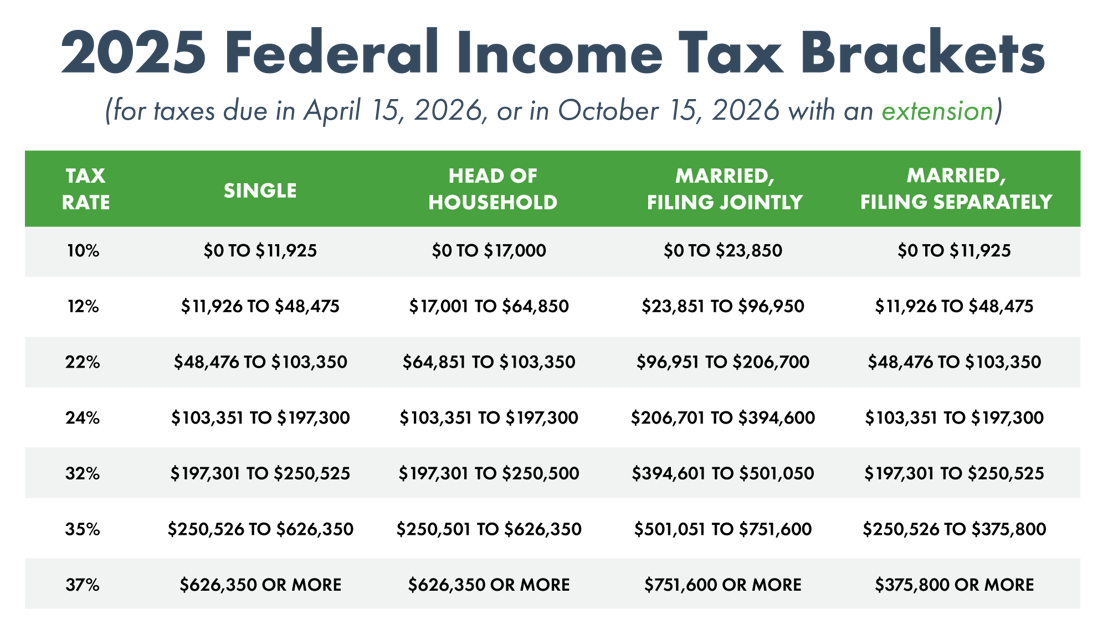
Federal income tax brackets are adjusted each year for inflation, and for tax year 2025 (the return you file in 2026), filing status can make a meaningful difference — especially for married couples.
For couples who file jointly, the highest federal tax rate of 37% doesn’t apply until taxable income exceeds $751,600, effectively allowing more income to be taxed at lower rates. By contrast, couples who file separately hit that same 37% rate at $375,800, which is essentially half the joint threshold.
This is why filing jointly often results in a lower overall tax burden for married households — though filing separately can still make sense in certain situations, depending on income structure, deductions, or individual circumstances. The chart below breaks down all brackets by filing status so you can see exactly where each threshold falls.
 Due to inflation, the cost of everyday items has grown more expensive, increasing the cost of living. The IRS works with the overall cost of living and adjusts tax brackets to reflect what that looks like for individuals and families alike.
2025 Tax Deductions
2025 Standard Tax Deductions
A standard deduction is one where you have not made any itemized deductions and are working with the part of your income that is non-taxable. For 2025, the standard deduction is:
-
$15,750 for single filers (and married filing separately)
-
$31,500 for married couples filing jointly
-
$23,625 for head of household
2025 Itemized Tax Deductions
Itemizing your deductions takes more time and effort but may be beneficial if you end up with more than a standard deduction will give you. If you aren’t sure what’s best for you, we recommend reaching out to a tax professional to help you decide.
If you do want to itemize your deductions, here are some things you may be able to add to that list:
- Health insurance
- Mortgage interest
- Medical bills
- Student loan interest
- Educational bills such as tuition
- Donations to charities and non-profits
- State taxes
- Local taxes
- Home improvement (energy saving)
- Electric car credit
- Business expenses
- HSA (Health Savings Account) contributions
It’s important to note this is a condensed list and there are limits from the IRS on any itemized deductions. As we stated above, the best bet is to speak to an accountant or tax professional with any concerns.
What’s New with Taxes in 2026?
The IRS released its latest inflation adjustment guidance with updates that affect far more than tax brackets. Here are a few highlights worth knowing this year.
HSAs and FSAs
Flexible Spending Accounts (FSAs)
For 2026 plan years, the health FSA contribution limit rises to $3,400, and the maximum carryover (if your plan allows it) increases to $680.
Health Savings Accounts (HSAs)
For 2026, HSA contribution limits increase to:
-
$4,400 for individual coverage
-
$8,750 for family coverage (Catch-up contributions for age 55+ are still allowed under separate rules.)
Updated Gift and Estate Tax Exclusion
For 2026, the lifetime estate and gift tax exclusion increases to $15,000,000 per person (and the annual gift exclusion remains $19,000 per recipient).
2025 Child Tax Credit Update
To claim the Child Tax Credit (CTC) for 2025 (filed in 2026), your child must meet certain criteria, including age, relationship, and support requirements. They must generally be under 17 at the end of 2025, be claimed as your dependent, and meet the IRS qualifying rules.
A key update many families will notice is the maximum CTC amount for tax year 2025 is $2,200 per qualifying child, and the refundable portion (ACTC) can be up to $1,700 per child.
Income phaseouts remain an important consideration, and the best way to confirm how this applies to your household is to work with a qualified tax professional.
2025 Earned Income Tax Credit (EITC)
EITC is a refundable credit designed for low- and moderate-income workers. The IRS inflation adjustments increased the maximum EITC for those with three or more qualifying children, and these limits continue to update year to year.
IRS Free File
If you want a free way to file, IRS Free File is available for taxpayers with $89,000 or less in adjusted gross income (AGI). Click here to learn more!
A Quick Note on Direct File
Last year, you may have heard about IRS Direct File. For the 2026 filing season, the IRS is emphasizing Free File as the main no-cost online filing option. (Availability and options can change, so check IRS guidance for the latest.)
No matter if you’re single, married, doing a standard deduction, or itemizing, making sure your taxes are correct is crucial. When in doubt, hire a professional. It just may help you get more out of your tax return this year.
Please remember this article is just a guideline and Churchill Mortgage does not give any tax advice. Now, if you’re hoping to buy or refinance in 2026 and are looking for home loan advice, we’re here to help. Connect with a Home Loan Specialist.
The information contained herein is general in nature and based on authorities that are subject to change. Churchill Mortgage guarantees neither the accuracy nor completeness of any information and is not responsible for any errors or omissions, or for results obtained by others as a result of reliance upon such information. Churchill Mortgage assumes no obligation to inform the reader of any changes in tax laws or other factors that could affect information contained herein. This publication does not, and is not intended to, provide legal, tax or accounting advice, and readers should consult their tax advisors concerning the application of tax laws to their particular situations.
Frequently Asked Questions
Check our FAQs for responses to our most popular questions about the 2026 tax season.