
<img height="1" width="1" style="display:none" src="https://www.facebook.com/tr?id=1955936548054264&amp;ev=PageView&amp;noscript=1">
 

What Is a Debt-to-Income (DTI) Ratio?

Published: | Time to Read: 5 minutes | Word Count: 0


When it comes to getting approved for a mortgage, your debt-to-income ratio carries serious weight. In fact, according to a NerdWallet study, a high DTI ratio was the #1 reason lenders denied mortgage applications in 2022. Let’s break it down!

Key Takeaways:

  • Your DTI is just as important as your credit score when applying for a mortgage.
  • Lenders use your DTI to decide how much you can borrow and whether you qualify.
  • Lenders generally prefer a DTI ratio below 36%.
  • You can lower your DTI by paying off debt, boosting your income, or both.

What Is a DTI Ratio?

Your debt-to-income ratio (DTI) is a number lenders look at to see how much of your monthly income goes toward debt. It’s found using a simple formula—the lower your DTI, the better your chances of getting approved for a home loan. Here’s the formula: 

 

Debt-to-income ratio formula


Say you make $7,000 before taxes each month. You owe $350 for your car loan, $250 for student loans, $200 on credit cards, and you’re planning on a mortgage payment of $1,800.


Your total debt = $2,600
Your income = $7,000
Your DTI = ($2,600 ÷ $7,000) x 100 = 37%


That would be your back-end DTI, and this example is just barely within the typical range for most lenders.


Front-End vs. Back-End DTI

There are two types of DTI ratios lenders care about:

What Is a Front-End DTI Ratio?

This includes your expected housing costs (mortgage, property taxes, homeowners' insurance, and mortgage insurance) divided by your gross monthly income. Most lenders like to see this under 28%.

What Is a Back-End DTI Ratio?

This includes all your monthly debts (credit cards, car loans, student loans, and your future mortgage payments). The number to aim for here is below 36%, though some loans allow up to 50% if you meet other criteria. Think of back-end DTI as the "big picture" of your finances.


See if your DTI is mortgage-ready.

Connect with a local Churchill expert to review your numbers and explore your next steps toward approval.

Why Does Your DTI Ratio Matter?

Lenders use your debt-to-income ratio to gauge risk. If too much of your income is already going toward debt, it raises a red flag. You might be more likely to fall behind on payments if something unexpected comes up.

Missed payments can lead to foreclosure, which is a risk lenders want to avoid. Even if the numbers technically work, lenders want to be confident that your mortgage won’t stretch you too thin.


What Is a “Good” DTI Ratio?

Here’s a quick breakdown by loan type:
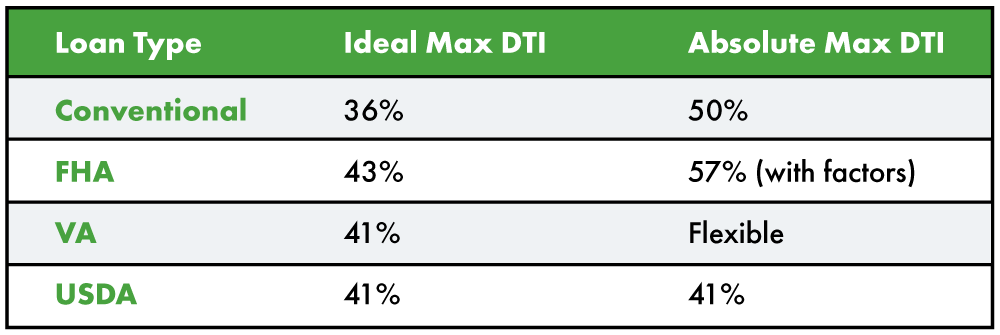
Debt-to-income ratio min and max by mortgage loan type

Note: Just because you can get approved with a high DTI ratio doesn’t mean you should. Lower is better, both for approval odds and your ability to pay back your mortgage.


How to Calculate Your DTI Ratio

We will be using that formula from earlier, dividing your monthly debt payments by your monthly income and multiplying it by 100. Here's what each of those values should include:

Your Monthly Debts:

  • Minimum credit card payments
  • Auto loans or leases
  • Student loans
  • Personal loans
  • Alimony or child support
  • Your estimated future mortgage payment

Your Monthly Gross Income:

This is your income before taxes. Including:

  • Your salary
  • Bonuses
  • Freelance income (if consistent)
  • Child support

Then plug it into the formula, multiply by 100, and you’ve got your percentage.


How to Lower Your DTI Ratio

If your DTI is pushing the limits, don’t panic. Just like your credit score, your DTI ratio can be improved over time. Here are a few ways you can lower your DTI ratio.

Pay Down Debts

Knocking out even one monthly payment can make a big difference. If you’re close to paying off your car or a credit card, it might be worth wrapping that up before applying.

Avoid New Debt

Now’s not the time to buy a new couch on credit or take out a new loan. Keep your finances steady until the homebuying process is complete.

Increase Your Income

Easier said than done, but even picking up a side hustle or freelance work can help tip the ratio in your favor.

Wait And Reassess

If your DTI is over 50%, it might be smart to wait a bit before applying for a mortgage. Use the time to build a stronger financial foundation.


Your DTI gives lenders a snapshot of how comfortably you can afford a new home. And while lenders may have their own limits, the real goal is making sure you’re making a smart decision for your financial future.

So, before you fall in love with that dream home, crunch the numbers. If your DTI could use some work, take the time to fix it. Want help figuring out your DTI or prepping for a mortgage? Click here to connect with a Home Loan Specialist.


Frequently Asked Questions

Check our FAQs for responses to our most popular questions about debt-to-income ratio.

purchase-g-radio
Why does my debt-to-income ratio (DTI) matter when getting a home loan?

At Churchill Mortgage, we use your DTI to evaluate how much of your monthly income goes toward debts — including future housing costs. A lower DTI means you’re in a stronger position to handle your mortgage payments, which improves your approval chances and helps us recommend the right loan program for you.

purchase-g-radio
What’s a good debt-to-income ratio for buying a house?

Most lenders prefer to see a DTI under 36%, but that number can vary depending on your credit score and loan type. At Churchill Mortgage, we help home buyers understand what their specific ratio means and what loan options may still be available — even if they’re slightly above that range.

Can I buy a house with a high DTI ratio?

It’s possible, but it might limit your options. A higher DTI can make lenders cautious, but there are strategies to strengthen your application. A Churchill Loan Officer can review your full financial picture and show you ways to improve your approval odds — whether that’s paying down debt or exploring alternative loan programs.

How can I lower my DTI before applying for a mortgage?

You can lower your DTI by paying off smaller debts, avoiding new credit, or boosting your income. Our team at Churchill Mortgage can help you make a plan to do this strategically — and determine how close you are to mortgage-ready.

Does a good credit score offset a high DTI?

Sometimes, yes. Lenders look at your overall financial health, not just one number. A strong credit score, consistent income, and solid savings can balance out a higher DTI. Churchill Mortgage takes a holistic approach when reviewing applications — we look for reasons to help you qualify, not reasons to say no.

Are you buying a home or refinancing?

Where are you planning to buy a home?

Please Select a State

When are you planning to buy a home?

Establishing a timeline helps you plan and organize the stages and tasks when buying a home.

What is your timeline?

What is your full name?

Please Enter a Name
Please Enter a Last Name

What is your email address?

Please Enter a Valid Email Address
  We won't share your information.

Next, we need to verify a phone number.

Enter a Valid Phone Number
Please Select a Message Type

Please Select Yes or No

Enter your phone number and we'll text you a 6-digit security code to verify it's you. By checking "Yes, I would like to receive text messages," you are consenting to receive recurring marketing/account notifications from Churchill. Standard texting and data rates may apply. Message frequency may vary. Text the word HELP to 615-488-4941 for more information. You can opt out by responding STOP at any time. SMS consent is not extended to third parties. For more information, read our Privacy Policy, Mobile Policy and Terms & Conditions.

Enter the 6-digit code sent to your device.

 Code sent to +1234567890

Finally, how did you hear about us?

Please Select an Option

By submitting this form, I/we agree to your Privacy Policy, Email and Mobile Policy, Terms of Use and authorize Churchill Mortgage Corporation and/or their Preferred Provider for our area and/or The Churchill Agency to receive the above information to assist in obtaining a home loan.

I/we also authorize Churchill Mortgage Corporation, The Churchill Agency and/or their Preferred Provider for our area to contact us regarding but not limited to mortgage and insurance services and products via telephone, mobile phone (including through automated dialing), and/or email, even if telephone numbers or email I/we provide are on any Do Not Call/Contact Registry, such as corporate, state, or the National Do Not Call Registry. The submission of this form does not constitute in any way a formal loan application or a commitment for a loan. By communicating with us by phone, you consent to calls being recorded and monitored. For more information, read our Privacy Policy, Mobile Policyand Terms & Conditions. Consent to these terms is not a condition of purchase.

Your answer will NOT negatively affect your mortgage application. Your answer does not mean the Lender or Other Loan Participants agree to communicate or provide documents to you in your preferred language. However, it may let them assist you or direct you to persons who can assist you. Language assistance and resources may be available through housing counseling agencies approved by the U.S. Department of Housing and Urban Development. To find a housing counseling agency, contact one of the following Federal government agencies. U.S. Department of Housing and Urban Development (HUD) at (800)569-4287 or www.hud.gov/counseling

Es probable que su transacción de préstamo hipotecario suceda en inglés. Por medio de esta pregunta, solicitamos información para determinar si existen comunicaciones disponibles a su servicio, en su idioma preferido. Sírvase tener en cuenta: posiblemente NO hay comunicaciones disponibles en su idioma preferido.

Thank You!

Thank you for choosing Churchill Mortgage to help you with your home loan needs!

Our team is already hard at work connecting you with your Home Loan Specialist. Rest assured that we've received your request and will be in touch with you shortly.

social proof logos

Already working with someone at Churchill?

Find Your Home Loan Specialist

Please Select a Loan Officer